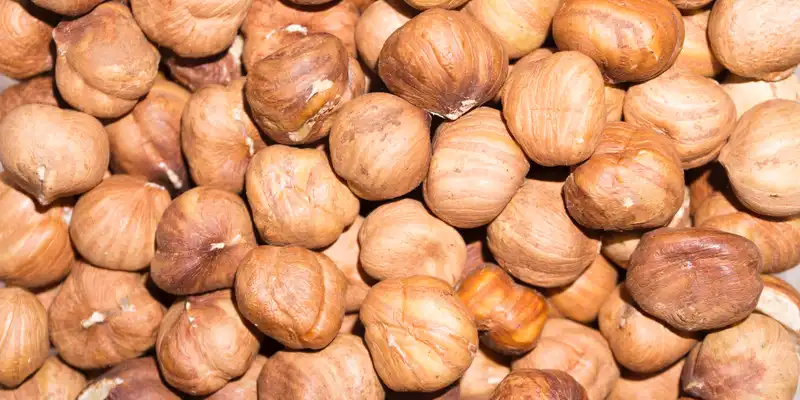
Dry roasted hazelnuts – nutrition facts and benefits
% of daily value per 100 g
32%
646 kcal
Calories
30%
15 g
Protein
6%
18 g
Carbohydrate
80%
62 g
Fat
General nutrients
Key components of food that provide the body with energy and all the necessary substances for life, growth, and normal functioning.
Water Total water includes all water contained in food, beverages, and drinking water. For infants age 0-6 months, water intake is assumed to be from human milk. For infants age 7-12 months, water intake is assumed to be from human milk, complementary foods and beverages. 2.52 g
-
Calories 646.00 kcal
32%
Protein 15.03 g
30%
Fat 62.40 g
80%
Ash 2.45 g
-
Carbohydrate 17.60 g
6%
Carbohydrates
The main source of energy. Read more
Fiber In adults there is evidence of benefit to health associated with consumption of diets rich in fiber-containing foods at dietary fiber intakes greater than 25 g per day, e.g. reduced risk of coronary heart disease and type 2 diabetes and improved weight maintenance. 9.40 g
33%
Sugars 4.89 g
-
Sucrose 4.75 g
-
Glucose 0.07 g
-
Fructose 0.07 g
-
Lactose 0.00 g
-
Maltose 0.00 g
-
Starch 1.10 g
-
Minerals
Support metabolism, bone formation, nerve impulse transmission, water-salt balance, and immune function. Read more
Calcium food.essential 123.00 mg
9%
Iron food.essential For premenopausal women (including lactating and pregnant women), the recommended intake covers the requirement of approximately 95 % of women. Depends on the blood loss during menstruation. 4.38 mg
24%
Magnesium food.essential The upper limit represents intake from a pharmacological agent only and does not include intake from food and water. 173.00 mg
41%
Phosphorus food.essential 310.00 mg
24%
Potassium food.essential 755.00 mg
16%
Sodium food.essential 0.00 mg
0%
Zinc food.essential The amount of zinc absorbed from food ranges from 5% to over 50% depending on the level of phytate intake (LPI), which depends on the amount of plant foods in the diet. 2.50 mg
22%
Copper food.essential 1.75 mg
194%
Manganese food.essential 5.55 mg
241%
Selenium food.essential 4.10 mcg
7%
Vitamins (fat-soluble)
Important for metabolism, growth, and regulation of bodily functions. Read more
Vitamin A food.essential Values are presented in RAE: retinol activity equivalent. Provitamin A carotenoids have a lower bioavailability than retinol. In order to take into account these differences, RAE have been introduced and defined as 1 mcg RAE = 1 mcg retinol = 12 mcg β-carotene = 24 mcg α-carotene = 24 mcg β-cryptoxanthin. The RAE for dietary provitamin A carotenoids is two-fold greater than retinol equivalents (REs), whereas the RAE for preformed vitamin A is the same as RE. 3.00 mcg
0%
Retinol food.essential 0.00 mcg
-
Beta-carotene food.essential 36.00 mcg
-
Alpha-carotene food.essential 1.00 mcg
-
Vitamin E Alpha-tocopherol food.essential 15.28 mg
101%
Vitamin D Calciferol food.essential Assumes minimal vitamin D synthesis from sunlight. In the presence of endogenous vitamin D synthesis, the requirement for dietary vitamin D is lower or may even be zero. 0.00 mcg
0%
Vitamins (water-soluble)
Participate in energy metabolism, nervous system function, and cell growth. Read more
Vitamin C Ascorbic acid food.essential Smokers have an increased vitamin C requirement. 3.80 mg
4%
Vitamin B1 Thiamin food.essential 0.34 mg
28%
Vitamin B2 Riboflavin food.essential 0.12 mg
9%
Vitamin B3 Niacin food.essential Niacin can be synthesized in the human body from the indispensable amino acid tryptophan. Values are presented in NE: niacin equivalent (1 NE = 1 mg niacin = 60 mg dietary tryptophan); 0–6 months = preformed niacin (not NE). The upper limit applies to synthetic forms obtained from supplements, fortified foods, or a combination of the two. 2.05 mg
12%
Vitamin B5 Pantothenic acid food.essential 0.92 mg
18%
Vitamin B6 Pyridoxine food.essential For infants, only breast milk, formula, and food should be the sources of vitamin B6. 0.62 mg
36%
Folic acid food.essential 0.00 mcg
-
Folate food.essential 88.00 mcg
-
Vitamin B9 Folate DFE food.essential DFE: dietary folate equivalents. Natural food folates have a lower bioavailability than folic acid. DFE have been introduced to account for these differences. 88.00 mcg
22%
Vitamin B12 Cobalamin food.essential 0.00 mcg
0%
Amino acids
Participate in the synthesis of proteins, hormones, enzymes, and neurotransmitters. Read more
Tryptophan food.essential 0.19 g
-
Threonine food.essential 0.50 g
-
Isoleucine food.essential 0.55 g
-
Leucine food.essential 1.07 g
-
Lysine food.essential 0.42 g
-
Methionine food.essential 0.22 g
-
Cystine food.essential 0.28 g
-
Phenylalanine food.essential 0.67 g
-
Tyrosine food.essential 0.36 g
-
Valine food.essential 0.71 g
-
Arginine 2.22 g
-
Histidine food.essential 0.43 g
-
Alanine 0.73 g
-
Aspartic acid 1.69 g
-
Glutamic acid 3.73 g
-
Glycine 0.73 g
-
Proline 0.56 g
-
Serine 0.74 g
-
Saturated fatty acids
Provide energy and participate in the construction of cell membranes and hormones. Read more
Saturated fatty acids 4.51 g
22%
Caprylic acid 0.00 g
-
Capric acid 0.00 g
-
Lauric acid 0.00 g
-
Tridecylic acid 0.00 g
-
Myristic acid 0.00 g
-
Pentadecylic acid 0.00 g
-
Palmitic acid 3.18 g
-
Margaric acid 0.00 g
-
Stearic acid 1.27 g
-
Arachidic acid 0.06 g
-
Behenic acid 0.00 g
-
Lignoceric acid 0.00 g
-
Monounsaturated fatty acids
Support cell health, improve blood lipid profile and metabolism. Read more
Monounsaturated fatty acids 46.61 g
-
Myristoleic acid Omega-5 0.00 g
-
Hexadecenoic acid 0.12 g
-
Octadecenoic acid 46.35 g
-
Gondoic acid Omega-9 0.13 g
-
Erucic acid Omega-9 0.00 g
-
Nervonic acid Omega-9 0.00 g
-
Polyunsaturated fatty acids
Essential components involved in maintaining cell membrane flexibility, regulating inflammation, cholesterol levels, and hormonal balance. Read more
Polyunsaturated fatty acids 8.46 g
-
Octadecadienoic acid 8.40 g
-
Octadecatrienoic acid 0.06 g
-
Eicosadienoic acid Omega-6 0.00 g
-
Eicosatrienoic acid 0.00 g
-
Eicosatetraenoic acid 0.00 g
-
Eicosapentaenoic acid EPA Omega-3 food.essential 0.00 g
-
Docosapentaenoic acid DPA Omega-3 0.00 g
-
Docosahexaenoic acid DHA Omega-3 food.essential 0.00 g
-
Sterols
Important components of cell membranes that regulate their fluidity and permeability. Read more
Cholesterol 0.00 mg
0%
Phytosterols 110.00 mg
-
Stigmasterol 1.00 mg
-
Campesterol 6.00 mg
-
Beta-sitosterol 103.00 mg
-
Other
Other bioactive compounds that affect physiological processes but do not belong to the main classes of nutrients.
Ethyl alcohol 0.00 g
-
Help us get better!
Answer 3 questions