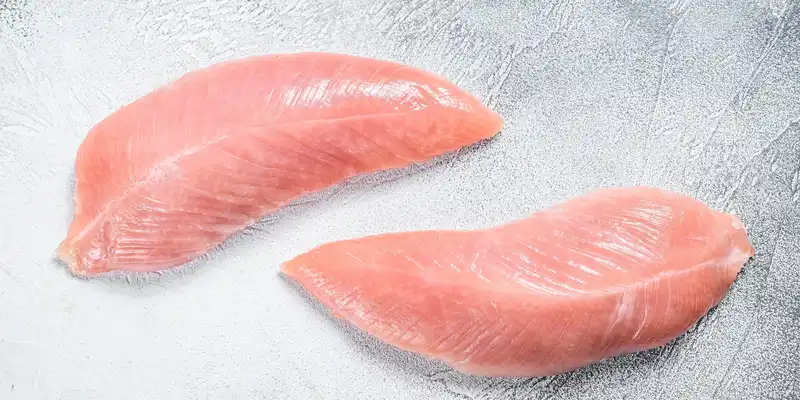
Duck breast (meat only) – nutrition facts and benefits
* refine options for better results
% of daily value per 100 g
7%
140 kcal
Calories
55%
28 g
Protein
0%
0 g
Carbohydrate
3%
3 g
Fat
General nutrients
Key components of food that provide the body with energy and all the necessary substances for life, growth, and normal functioning.
Water Total water includes all water contained in food, beverages, and drinking water. For infants age 0-6 months, water intake is assumed to be from human milk. For infants age 7-12 months, water intake is assumed to be from human milk, complementary foods and beverages. 68.25 g
-
Calories 140.00 kcal
7%
Protein 27.60 g
55%
Fat 2.50 g
3%
Ash 1.40 g
-
Carbohydrate 0.00 g
0%
Minerals
Support metabolism, bone formation, nerve impulse transmission, water-salt balance, and immune function. Read more
Calcium food.essential 9.00 mg
0%
Iron food.essential For premenopausal women (including lactating and pregnant women), the recommended intake covers the requirement of approximately 95 % of women. Depends on the blood loss during menstruation. 4.49 mg
24%
Sodium food.essential 105.00 mg
4%
Selenium food.essential 29.00 mcg
52%
Vitamins (water-soluble)
Participate in energy metabolism, nervous system function, and cell growth. Read more
Vitamin C Ascorbic acid food.essential Smokers have an increased vitamin C requirement. 3.20 mg
3%
Vitamin B3 Niacin food.essential Niacin can be synthesized in the human body from the indispensable amino acid tryptophan. Values are presented in NE: niacin equivalent (1 NE = 1 mg niacin = 60 mg dietary tryptophan); 0–6 months = preformed niacin (not NE). The upper limit applies to synthetic forms obtained from supplements, fortified foods, or a combination of the two. 10.35 mg
64%
Amino acids
Participate in the synthesis of proteins, hormones, enzymes, and neurotransmitters. Read more
Tryptophan food.essential 0.38 g
-
Threonine food.essential 1.17 g
-
Isoleucine food.essential 1.40 g
-
Leucine food.essential 2.31 g
-
Lysine food.essential 2.34 g
-
Methionine food.essential 0.74 g
-
Cystine food.essential 0.42 g
-
Phenylalanine food.essential 1.15 g
-
Tyrosine food.essential 1.04 g
-
Valine food.essential 1.43 g
-
Arginine 1.74 g
-
Histidine food.essential 0.72 g
-
Alanine 1.73 g
-
Aspartic acid 2.68 g
-
Glutamic acid 4.28 g
-
Glycine 1.53 g
-
Proline 1.34 g
-
Serine 1.18 g
-
Saturated fatty acids
Provide energy and participate in the construction of cell membranes and hormones. Read more
Saturated fatty acids 0.58 g
2%
Myristic acid 0.01 g
-
Palmitic acid 0.42 g
-
Stearic acid 0.15 g
-
Monounsaturated fatty acids
Support cell health, improve blood lipid profile and metabolism. Read more
Monounsaturated fatty acids 0.87 g
-
Hexadecenoic acid 0.07 g
-
Octadecenoic acid 0.79 g
-
Gondoic acid Omega-9 0.01 g
-
Polyunsaturated fatty acids
Essential components involved in maintaining cell membrane flexibility, regulating inflammation, cholesterol levels, and hormonal balance. Read more
Polyunsaturated fatty acids 0.38 g
-
Octadecadienoic acid 0.30 g
-
Octadecatrienoic acid 0.01 g
-
Eicosatetraenoic acid 0.06 g
-
Sterols
Important components of cell membranes that regulate their fluidity and permeability. Read more
Cholesterol 143.00 mg
47%
Help us get better!
Answer 3 questions